
Identify your pages with the highest traffic
Click performance.
Click on the "Page" tab (next to Queries).
Change the date range to "Last 12 months." (A full year gives you a complete description of your traffic, but don't hesitate to adjust the period of time).
Make sure "Total clicks" is selected.
Click on the small down arrow next to "Clicks" to order from highest to lowest.
Click on the "Queries" tab.
Change the date range to "Last 12 months." (A full year gives you a complete description of your traffic, but don't hesitate to adjust the period of time).
Be sure to select "average CTR".
Click on the small down arrow next to "CTR" to sort from highest to lowest.
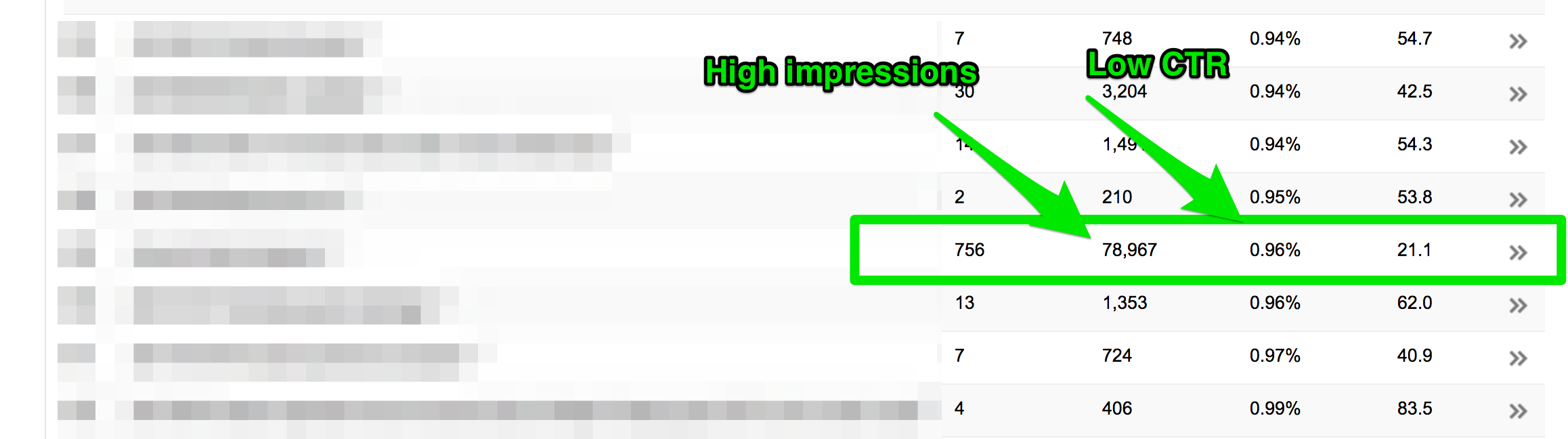
Note: It is useful to see this together with "Impressions" (check "Total Impressions" to view this information in parallel). A page can have a high CTR but low impressions, or vice versa: you will not get the full image without both data points.
Click performance.
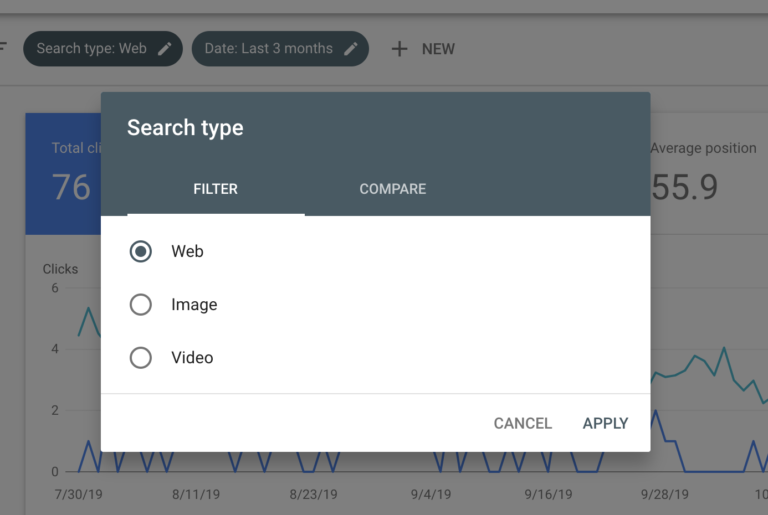
Click on the date to adjust the time period. Choose the range that interests you. (Alternatively, click "Compare" to analyze two ranges of dates at once.)
Look at "average CTR."
Click performance.
Click on the date to adjust the time period. Choose the range that interests you. (Alternatively, click "Compare" to analyze two ranges of dates at once.)
See "Total Impressions."
Go to Status> Performance.
Click on the date to adjust the time period. Choose the range that interests you. (Alternatively, click "Compare" to analyze two ranges of dates at once.)
Look at "Middle position."
I recommend watching the CTR. Any significant movement is significant: if it falls, but impressions have increased, you are simply qualifying for more keywords, so the average CTR has decreased. If the CTR has increased and impressions have decreased, you have lost keywords. If both CTR and impressions have increased, congratulations, you are doing something right!
As you create more content and optimize your existing pages, this number should increase. (As always, there are exceptions: maybe you decided to target a small number of high conversion keywords instead of many of the average conversions, focusing on other channels, etc.)
The average position is not as useful at a macro level. Most people are worried when it goes up, but that is myopic. If a page or set of pages begins to qualify for additional keywords, the average position generally increases; After all, unless you are qualifying for the same position or better than your existing keywords, your "average" will increase.
Do not pay too much attention to this metric.
Click performance.
Click on the "Page" tab.
Change the date range to "Last 28 days." (You want an updated and accurate snapshot of your pages).
Make sure that the "Average position" is selected.
Click on the small up arrow next to "Position" to sort from the smallest (good) to the highest (bad).
Click performance.
Click on the "Page" tab.
Change the date range to "Last 28 days." (You want an updated and accurate snapshot of your pages).
Make sure that the "Average position" is selected.
Click on the small down arrow next to "Position" to sort from highest to lowest (good).
Because you are viewing the average position by URL, that number is the average of all rankings on that page. In other words, if you qualify for two keywords, it could be # 1 for a high volume query and # 43 for a low volume one, but the average will remain 22.
With that in mind, don't judge the success or failure of a page just by "average position."
Click on the "Query" tab.
Click on "Date Range" to change dates, then choose the "Compare" tab.
Select two equivalent time periods,then click on "Apply".
At this point, you can view the data in GSC or export it. For an in-depth analysis, I recommend the second: it will make your life much easier.
To do so, click on the down arrow below "Search Aspect", then download it as a CSV file or export it to Google Sheets.
After having this data in the form of a spreadsheet, you can add a column for the position differences (Position of the last 28 days - Position of the previous 28 days), then sort by size.
If the difference is positive, your site has moved up for that query. If it is negative, you have fallen.
Click performance.
Click on the "Query" tab.
Click on "Date Range" to choose a period of time.
Make sure "Total clicks" is selected.
Click on the small down arrow next to "Clicks" to order from highest to lowest.
Knowing which queries generate more search traffic is definitely useful. Consider optimizing the ranking pages for the conversion, updating them periodically to maintain their ranking, leaving behind the paid promotion, using them to link to relevant pages of lower ranking (but as if they were not more important), and so on.
Click performance.
Go to the "Devices" tab.
Be sure to select "Total clicks," "Total impressions," "Average CTR," and "Average position."
Compare your performance on desktop computers, mobile devices and tablets.
Click performance.
Go to the "Countries" tab.
Be sure to select "Total clicks," "Total impressions," "Average CTR," and "Average position."
Compare your performance in all nations.
Start in "Overview".
Scroll down to the summary coverage index.
Look at the "valid pages" count.
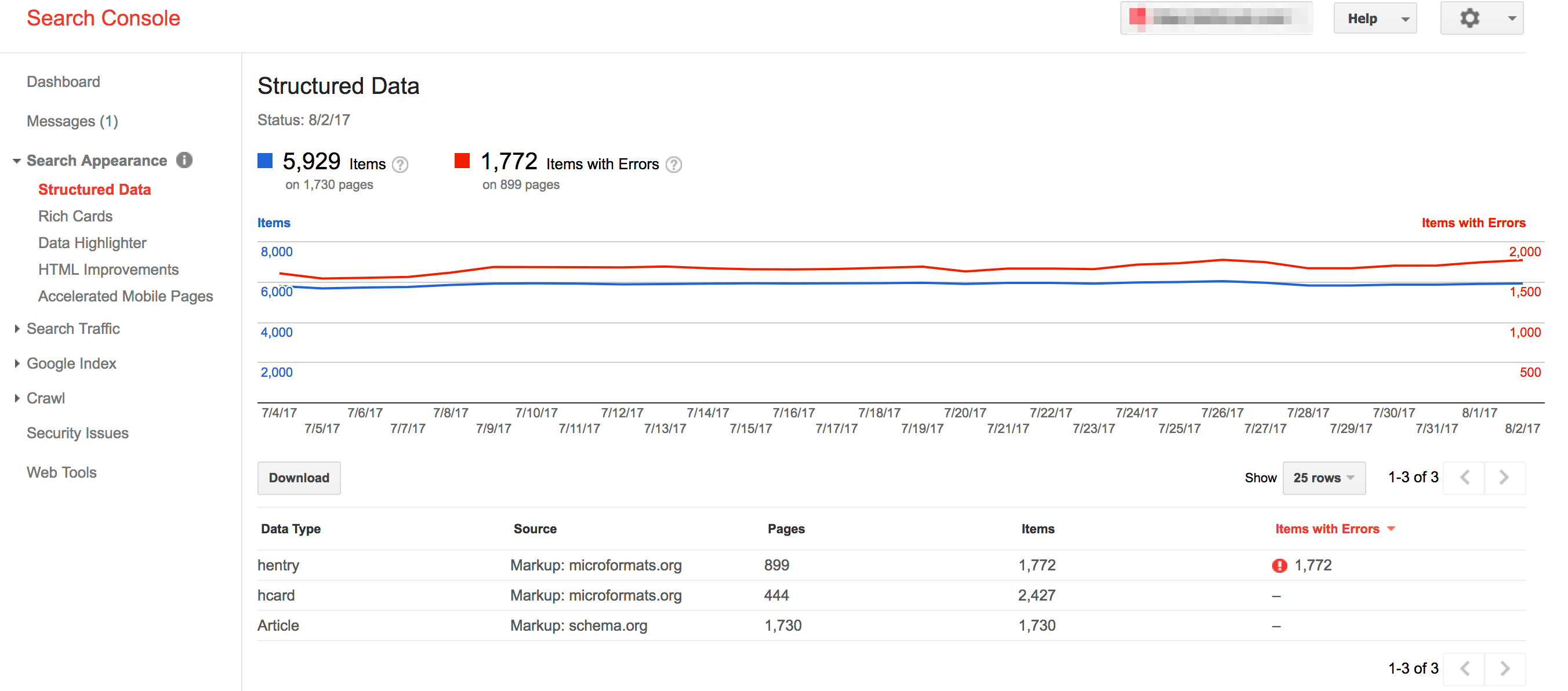
Go to Overview> Index coverage.
Scroll down to the Details box to find out what errors are causing indexing problems and how often they are.
Double-click on any type of error to see the URLs of the affected page.
Go to Overview> Index coverage.
Make sure that "Error", "Valid with warnings", "Valid" and "Excluded" are all selected.
The total number of pages indexed on your site should normally increase over time as:
Publish new blog posts, create new landing pages, add additional site pages, etc.
Correct indexing errors
If indexing errors increase significantly, a change in the template of your site could be the culprit (because a large set of pages have been affected immediately). Alternatively, you may have sent a site map with URLs that Google cannot track (due to "noindex" directives, robots.txt, password protected pages, etc.).
If the total number of pages indexed on your site drops without a proportional increase in errors, you may be blocking access to existing URLs.
In any case, try to diagnose the problem by looking at its excluded pages and looking for clues.
Click Mobile Usability.
Make sure "Error" is selected.
Scroll down to the Details box to find out what errors are causing mobile usability problems and how often they are.
Double-click on any type of error to see the URLs of the affected page.
Click on links.
Open the main linked pages report.
Look at the box labeled "Total external links."
Click the down arrow next to "Inbound links" to sort the backlinks from highest to lowest.
Each backlink is a signal to Google that its content is reliable and useful. In general, the more backlinks, the better! Of course, quality is important: a link from a high authority site is much more valuable than two links from low authority sites. To see which sites are linked to a specific page, simply double-click on that URL in the report.
Click on links.
Open the main linked pages report.
Click the down arrow next to "Inbound links" to sort the backlinks from highest to lowest.
If you want to help a page have a higher rank,
Click on links.
Scroll down to "Main Link Sites"> "More."
Knowing your main reference domains is incredibly useful for promotion. I recommend starting with these sites whenever you carry out a link creation campaign. (Just be sure to use a tool like Moz, SEMrush or Ahrefs to first filter out the low authority ones).
These can also be good candidates for marketing campaigns or social media associations.
Click on links.
Scroll down to "Upper link text"> "More."
The anchor text should be as descriptive and specific as possible, and at best, include your keyword. If you find websites that link to your pages but use anchor text such as "Click here," "Get more information," "Check it," etc., consider sending an email asking them to update the hyperlink.
Click on links.
Scroll down to "Main linked pages"> "More."
It is normal for some URLs to have more incoming links. For example, if you run an e-commerce site, each product page in its "Skirts" category will be linked back to the "Skirts" overview page. That's good: it tells Google that the top-level URLs are the most important (which helps them get a higher ranking).
However, a highly skewed link distribution relationship is not ideal. If a small percentage of your URLs get many more links than the rest, it will be difficult for 95% to receive search traffic; It is not giving them enough authority.
This is what a very skewed distribution looks like:
The optimal distribution looks like this:
Use the GSC link data to find out how your links are distributed and if you need to focus on making your link distribution more fluid.
Click on links.
Scroll down to "Main linked pages"> "More."
Look at the box labeled "Total internal links"
Click on AMP.
Make sure "Error" is selected.
Scroll down to the "Details" box to see what types of problems you have and how often they are.
Google recommends correcting errors before looking at pages in the "Valid with warnings" category. By default, errors are classified by severity, frequency and if you have solved them.
Click on the white magnifying glass at the top of the page.
Enter the URL of the page. (Make sure it belongs to the property you are currently viewing.)
Here we explain how to interpret the results. If the URL is in Google, that means it is indexed and can appear in the search.
That does not mean that it will: if it has been marked as spam or if the content has been temporarily deleted or blocked, it will not appear. Google the URL; If it appears, search engines can find it.
Open the index coverage card for more information about the presence of the URL on Google, including which site maps point to this URL, the reference page that led Googlebot to this URL, the last time Googlebot crawled this URL , whether you have allowed Googlebot to crawl this URL, if Googlebot could really get this URL, if this page does not allow indexing, the canonical URL that you have set for this page and the URL that Google has selected as canonical for this page.
The Improvements section gives you information about:
The AMP version of this page, if it exists, and any specific AMP problem
Job publication status and / or structured recipe data
The new GSC, although intuitive and well designed, does not have all the features of the previous version. If you want to use the latter, click on "Go to the previous version" in the left sidebar menu

Click performance.
Click on the "Page" tab (next to Queries).
Change the date range to "Last 12 months." (A full year gives you a complete description of your traffic, but don't hesitate to adjust the period of time).
Make sure "Total clicks" is selected.
Click on the small down arrow next to "Clicks" to order from highest to lowest.
1. Identify your highest CTR queries
Click performance.Click on the "Queries" tab.
Change the date range to "Last 12 months." (A full year gives you a complete description of your traffic, but don't hesitate to adjust the period of time).
Be sure to select "average CTR".
Click on the small down arrow next to "CTR" to sort from highest to lowest.
Note: It is useful to see this together with "Impressions" (check "Total Impressions" to view this information in parallel). A page can have a high CTR but low impressions, or vice versa: you will not get the full image without both data points.
2. Look at the average CTR
Click performance.
Click on the date to adjust the time period. Choose the range that interests you. (Alternatively, click "Compare" to analyze two ranges of dates at once.)
Look at "average CTR."
Click performance.
Click on the date to adjust the time period. Choose the range that interests you. (Alternatively, click "Compare" to analyze two ranges of dates at once.)
See "Total Impressions."
Go to Status> Performance.
Click on the date to adjust the time period. Choose the range that interests you. (Alternatively, click "Compare" to analyze two ranges of dates at once.)
Look at "Middle position."
3. Control your CTR over time
I recommend watching the CTR. Any significant movement is significant: if it falls, but impressions have increased, you are simply qualifying for more keywords, so the average CTR has decreased. If the CTR has increased and impressions have decreased, you have lost keywords. If both CTR and impressions have increased, congratulations, you are doing something right!
4. Control your impressions over time.
As you create more content and optimize your existing pages, this number should increase. (As always, there are exceptions: maybe you decided to target a small number of high conversion keywords instead of many of the average conversions, focusing on other channels, etc.)
5. Monitor the average position over time
The average position is not as useful at a macro level. Most people are worried when it goes up, but that is myopic. If a page or set of pages begins to qualify for additional keywords, the average position generally increases; After all, unless you are qualifying for the same position or better than your existing keywords, your "average" will increase.
Do not pay too much attention to this metric.
6. Identify your highest ranking pages
Click performance.
Click on the "Page" tab.
Change the date range to "Last 28 days." (You want an updated and accurate snapshot of your pages).
Make sure that the "Average position" is selected.
Click on the small up arrow next to "Position" to sort from the smallest (good) to the highest (bad).
Click performance.
Click on the "Page" tab.
Change the date range to "Last 28 days." (You want an updated and accurate snapshot of your pages).
Make sure that the "Average position" is selected.
Click on the small down arrow next to "Position" to sort from highest to lowest (good).
Because you are viewing the average position by URL, that number is the average of all rankings on that page. In other words, if you qualify for two keywords, it could be # 1 for a high volume query and # 43 for a low volume one, but the average will remain 22.
With that in mind, don't judge the success or failure of a page just by "average position."
7. Identify your lowest ranking pages
8. Identify ranking increases and decreases
Click performance.Click on the "Query" tab.
Click on "Date Range" to change dates, then choose the "Compare" tab.
Select two equivalent time periods,then click on "Apply".
At this point, you can view the data in GSC or export it. For an in-depth analysis, I recommend the second: it will make your life much easier.
To do so, click on the down arrow below "Search Aspect", then download it as a CSV file or export it to Google Sheets.
After having this data in the form of a spreadsheet, you can add a column for the position differences (Position of the last 28 days - Position of the previous 28 days), then sort by size.
If the difference is positive, your site has moved up for that query. If it is negative, you have fallen.
9. Identify your highest traffic queries
Click performance.
Click on the "Query" tab.
Click on "Date Range" to choose a period of time.
Make sure "Total clicks" is selected.
Click on the small down arrow next to "Clicks" to order from highest to lowest.
Knowing which queries generate more search traffic is definitely useful. Consider optimizing the ranking pages for the conversion, updating them periodically to maintain their ranking, leaving behind the paid promotion, using them to link to relevant pages of lower ranking (but as if they were not more important), and so on.
10. Compare the search performance of your site on desktop computers, mobile devices and tablets
Click performance.
Go to the "Devices" tab.
Be sure to select "Total clicks," "Total impressions," "Average CTR," and "Average position."
Compare your performance on desktop computers, mobile devices and tablets.
11. Compare the search performance of your site in different countries
Click performance.
Go to the "Countries" tab.
Be sure to select "Total clicks," "Total impressions," "Average CTR," and "Average position."
Compare your performance in all nations.
12. Know how many of your pages have been indexed
Start in "Overview".
Scroll down to the summary coverage index.
Look at the "valid pages" count.
13. Learn which pages have not been indexed and why
Go to Overview> Index coverage.
Scroll down to the Details box to find out what errors are causing indexing problems and how often they are.
Double-click on any type of error to see the URLs of the affected page.
14. Monitor the total number of indexed pages and indexing errors
Make sure that "Error", "Valid with warnings", "Valid" and "Excluded" are all selected.
The total number of pages indexed on your site should normally increase over time as:
Publish new blog posts, create new landing pages, add additional site pages, etc.
Correct indexing errors
If indexing errors increase significantly, a change in the template of your site could be the culprit (because a large set of pages have been affected immediately). Alternatively, you may have sent a site map with URLs that Google cannot track (due to "noindex" directives, robots.txt, password protected pages, etc.).
If the total number of pages indexed on your site drops without a proportional increase in errors, you may be blocking access to existing URLs.
In any case, try to diagnose the problem by looking at its excluded pages and looking for clues.
15. Identify mobile usability issues
Click Mobile Usability.
Make sure "Error" is selected.
Scroll down to the Details box to find out what errors are causing mobile usability problems and how often they are.
Double-click on any type of error to see the URLs of the affected page.
16. Learn how many total backlinks your site has
Click on links.
Open the main linked pages report.
Look at the box labeled "Total external links."
Click the down arrow next to "Inbound links" to sort the backlinks from highest to lowest.
Each backlink is a signal to Google that its content is reliable and useful. In general, the more backlinks, the better! Of course, quality is important: a link from a high authority site is much more valuable than two links from low authority sites. To see which sites are linked to a specific page, simply double-click on that URL in the report.
17. Identify which URLs have the most backlinks
Click on links.
Open the main linked pages report.
Click the down arrow next to "Inbound links" to sort the backlinks from highest to lowest.
If you want to help a page have a higher rank,
18. Identify which sites link you most
Click on links.
Scroll down to "Main Link Sites"> "More."
Knowing your main reference domains is incredibly useful for promotion. I recommend starting with these sites whenever you carry out a link creation campaign. (Just be sure to use a tool like Moz, SEMrush or Ahrefs to first filter out the low authority ones).
These can also be good candidates for marketing campaigns or social media associations.
19. Identify the most popular anchor text for external links
Click on links.
Scroll down to "Upper link text"> "More."
The anchor text should be as descriptive and specific as possible, and at best, include your keyword. If you find websites that link to your pages but use anchor text such as "Click here," "Get more information," "Check it," etc., consider sending an email asking them to update the hyperlink.
20. Identify which pages have more internal links
Click on links.
Scroll down to "Main linked pages"> "More."
It is normal for some URLs to have more incoming links. For example, if you run an e-commerce site, each product page in its "Skirts" category will be linked back to the "Skirts" overview page. That's good: it tells Google that the top-level URLs are the most important (which helps them get a higher ranking).
However, a highly skewed link distribution relationship is not ideal. If a small percentage of your URLs get many more links than the rest, it will be difficult for 95% to receive search traffic; It is not giving them enough authority.
This is what a very skewed distribution looks like:
The optimal distribution looks like this:
Use the GSC link data to find out how your links are distributed and if you need to focus on making your link distribution more fluid.
21. Learn how many total internal links your site has
Click on links.
Scroll down to "Main linked pages"> "More."
Look at the box labeled "Total internal links"
22. Find and correct AMP errors
Click on AMP.
Make sure "Error" is selected.
Scroll down to the "Details" box to see what types of problems you have and how often they are.
Google recommends correcting errors before looking at pages in the "Valid with warnings" category. By default, errors are classified by severity, frequency and if you have solved them.
23. See Google how Google sees a URL
Click on the white magnifying glass at the top of the page.
Enter the URL of the page. (Make sure it belongs to the property you are currently viewing.)
Here we explain how to interpret the results. If the URL is in Google, that means it is indexed and can appear in the search.
That does not mean that it will: if it has been marked as spam or if the content has been temporarily deleted or blocked, it will not appear. Google the URL; If it appears, search engines can find it.
Open the index coverage card for more information about the presence of the URL on Google, including which site maps point to this URL, the reference page that led Googlebot to this URL, the last time Googlebot crawled this URL , whether you have allowed Googlebot to crawl this URL, if Googlebot could really get this URL, if this page does not allow indexing, the canonical URL that you have set for this page and the URL that Google has selected as canonical for this page.
The Improvements section gives you information about:
The AMP version of this page, if it exists, and any specific AMP problem
Job publication status and / or structured recipe data
24. Go to the previous version of Search Console
The new GSC, although intuitive and well designed, does not have all the features of the previous version. If you want to use the latter, click on "Go to the previous version" in the left sidebar menu
Tags:
Updates