
How to Use Google Search Console ? (2020 REPORTS)
google-search-console
- What is Google Search Console?
GSC (formerly Google Webmaster Tools) may be a free platform for anyone with an internet site to watch how Google views their site and optimize its organic presence. that has viewing your referring domains, mobile site performance, rich search results, and highest-traffic queries and pages.At any given time, I even have GSC open in two to 10 tabs. It’s helpful on a macro and micro level -- both once I got to find out what’s happened to a heavy-traffic blog post that suddenly dipped, and see what percentage impressions HubSpot is gaining month over month.
Free Download: SEO Starter Pack
I’m a content strategist on HubSpot’s SEO team, which suggests GSC is especially useful to me. But anyone who’s got an internet site can and will dip their toes in these waters. consistent with Google, whether you’re a business owner, SEO specialist, marketer, site administrator, web developer, or app creator, Search Console will are available handy.
I remember the primary time I opened GSC -- and it had been overwhelming. there have been plenty of labels I didn’t understand (index coverage?!?), hidden filters, and confusing graphs. Of course, the more I used it, the less confusing it became.
But if you would like to skip the training curve (and why wouldn’t you), good news: I’m getting to reveal everything I’ve learned about the way to use Google Search Console sort of a pro.
This guide covers:
Adding your website to Google Search Console
Setting up owners, users, and permissions
Submitting a site map
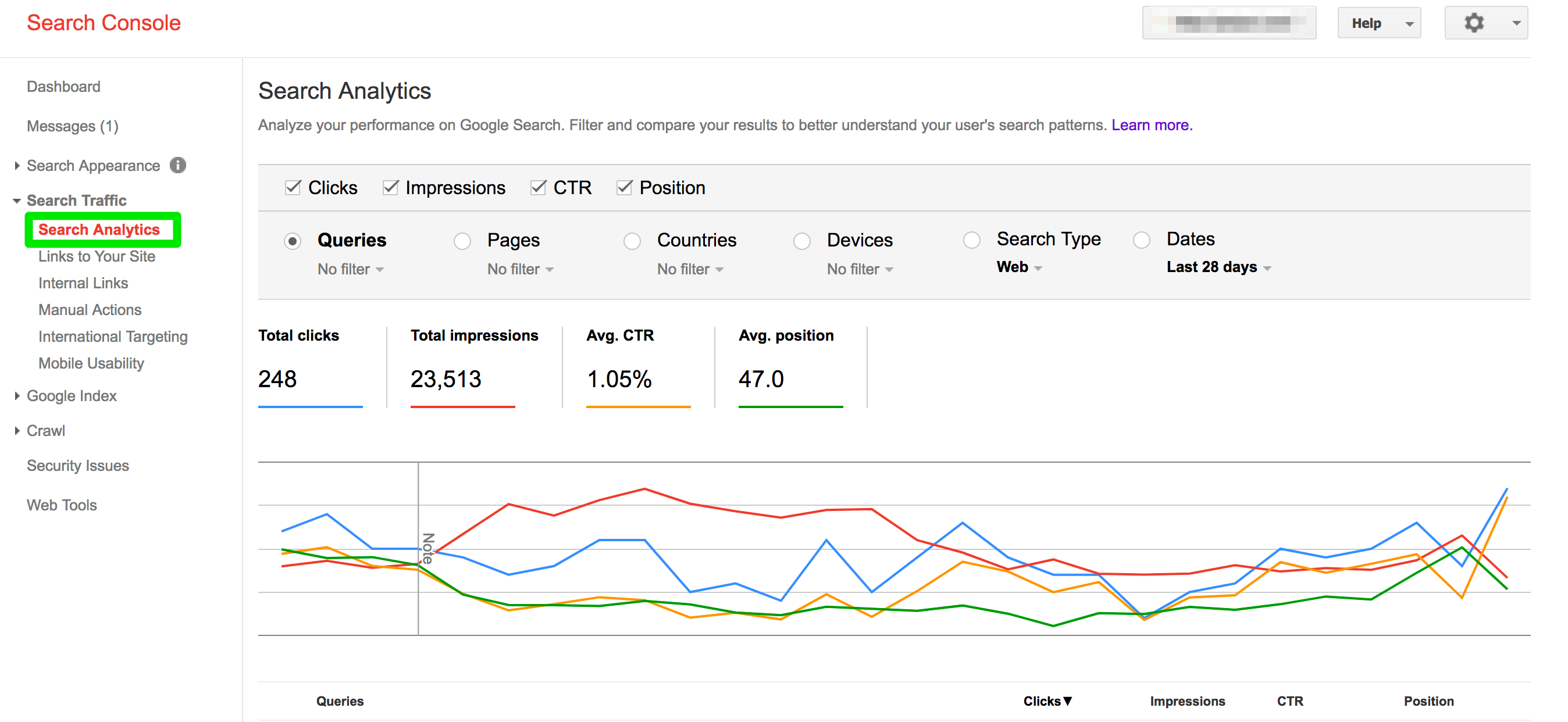
Understanding dimensions and metrics
Adding filters
Using GSC (23 use cases)
First things first. If you haven’t already signed up for GSC, it’s time to try to to so.
 |
| SEARCH |
- How to add your website to Google Search Console
Sign into your Google account. confirm you’re using your business (not personal) account if it’s a business website.Go to Google Webmaster Tools.
Click “Add a property.”
Choose “Website” from the menu and enter the URL of your site. confirm you’re using the precise URL that appears within the browser bar.
Click “Continue.”
Pick how to verify you own your website (HTML file upload, name provider, HTML tag, GA tracking code, or GTM container snippet).
If your site supports both http:// and https://, add both as separate sites. you want to also add each domain (for example, hubspot.com, blog.hubspot.com, and www.hubspot.com).
Google starts tracking data for your property as soon as you add it to GSC -- even before it’s verified you’re the location owner.
Verifying your Site on GSC
Because GSC gives you access to tip a few site or app’s performance (plus influence over how Google crawls that site or app!), you've got to verify you own that site or app first.
Verification gives a selected user control over a selected property. you want to have a minimum of one verified owner per GSC property.
Also, note that verifying your property doesn’t affect PageRank or its performance in Google search. Of course, the more information you've got , the better it's to rank higher -- but simply adding your website to GSC won’t automatically make your rankings go up.
GSC verification methods
HTML file upload: Upload a verification HTML file to a selected location of your website.
Domain name provider: Sign into your domain registrar (like GoDaddy, eNom, or networksolutions.com), and verify your site directly from GSC or add a DNS TXT or CNAME record.
HTML tag: Add a <meta> tag to the <HEAD> section of a selected page’s HTML code.
Google Analytics tracking code: Copy the GA tracking code that you simply use on your site. (You need “edit” permission in GA for this feature .)
Google Tag Manager container snippet code: Copy the GTM container snippet code related to your site. (You need View, Edit, and Manage container-level permissions in GTM for this feature .)
Google-hosted sites, including Blogger and Sites pages, are automatically verified.
WWW domain or not?
True or false: hubspot.com and www.hubspot.com are an equivalent domain.The answer? False! Each domain represents a special server; those URLs might look very similar, but from a technical perspective, they’re two unique domains.
However, if you type “hubspot.com” into your browser bar, you’ll land at “www.hubspot.com”. what's this sorcery?
HubSpot has chosen “www.hubspot.com” as its preferred, or canonical, domain. meaning we’ve told Google we would like all of our URLs displayed in search as “www.hubspot.com/……”. And when third parties link to our pages, those URLs should be treated as “www.hubspot.com/……” also .
If you don’t tell GSC which domain you favor , Google may treat the www and non-www versions of your domain as separate -- splitting all those page views, backlinks, and engagement into two. Not good.
(At this point you ought to also found out a 301 redirect from your non-preferred domain to your preferred one, if you haven’t already.)
GSC users, owners, and permissions
There are two GSC role-types. i do know you would possibly be itching to urge to the great stuff (cough the data) but it’s important to try to to this right.
Owner: An owner has total control over their properties in GSC. they will add and take away other users, change the settings, see all data, and access every tool. A verified owner has completed the property verification process, while a delegated owner has been added by a verified one. (Delegated owners can add other delegated owners.)
User: A user can see all data and take some actions, but can’t add new users. Full users can see most data and take some actions, while restricted users can only view most data.
Think carefully about who should have which permissions. Giving everyone full ownership might be disastrous -- you don’t want someone to accidentally change a crucial setting. attempt to give your team members even as much authority as they have and no further.
For example, at HubSpot, our technical SEO manager Victor Pan may be a verified owner. I’m an SEO content strategist, which suggests i exploit GSC heavily but don’t got to change any settings, so I’m a delegated owner. The members of our blogging team, who use GSC to research blog and post performance, are full users.
Here are detailed instructions on adding and removing owners and users in Search Console.
There’s a 3rd role: an associate. you'll associate a Google Analytics property with an enquiry Console account -- which can allow you to see GSC data in GA reports. you'll also access GA reports in two sections of Search Console: links to your site, and Sitelinks.
A GA property can only be related to one GSC site, and the other way around . If you’re an owner of the GA property, follow these instructions to associate it with the GSC site.
- Do you need a site map?
A site map isn’t necessary to point out up in Google search results. As long as your site is organized correctly (meaning pages are logically linked to every other) , Google says its web crawlers will normally find most of your pages.But there are four situations a site map will improve your site’s crawlability:
It’s really big. The more pages you've got , the better it's for Googlebot to miss any changes or additions.
It has many “isolated” pages. Any page that has few inbound links from other pages is harder for an internet crawler to get .
It’s new. Newer sites have few backlinks (links from other sites) making them less discoverable.
It uses rich media content and/or shows up in Google News. In these cases, your sitemap makes it easier for Google to format and display your site in search.
Once you’ve built your site map, submit it using the GSC site maps tool.
GSC site maps report
After Google has processed and indexed your site map, it'll appear within the Site maps report. You’ll be ready to see when Google last read your site map and the way many URLs it’s indexed.
GSC dimensions & metrics
There are a couple of terms you ought to understand before using GSC.
- What’s a Google Search Console query?
This is an enquiry term that generated impressions of your site page on a Google SERP. you'll only find query data in Search Console, not Google Analytics.
- What’s an impression?
Each time a link URL appears during a search result, it generates an impact . The user doesn’t need to scroll right down to see your search result for the impression to count.
- What’s a click?
When the user selects a link that takes them outside of Google Search, that counts together click. If the user clicks a link, hits the rear button, then clicks an equivalent link again -- still one click. If then, they click a special link -- that’s two clicks.
When a user clicks a link within Google Search that runs a replacement query, that’s not counted as a click.
Also, this doesn’t include paid Google results
What’s average position?
This is the mean ranking of your page(s) for a question or queries. Suppose our guide to SEO tools is ranking #2 for “SEO software” and #4 for “keyword tools.” the typical position for this URL would be 3 (assuming we were ranking for literally nothing else).
- What’s CTR?
CTR, or click-through rate, is adequate to Clicks divided by Impressions, multiplied by 100. If our post shows up in 20 searches, and generates 10 clicks, our CTR would be 50%.
- Filtering in Google Search Console
GSC offers several alternative ways to look at and parse your data. These filters are incredibly handy, but they will even be confusing when you’re familiarizing yourself with the tool.
- Search type
There are three search types: web, image, and video. I typically use “web,” since that’s where most of the HubSpot Blog traffic comes from, but if you get tons of visits from image and/or video search, confirm you adjust this filter accordingly.
You can also compare two sorts of traffic. Just click the “Compare” tab, choose the 2 categories you’re curious about , and choose “Apply.”
This can cause some interesting findings. for instance , I discovered this color theory 101 post is getting more impressions from image search than web (although the latter remains generating more clicks!).
- Date range
GSC now offers 16 months of knowledge (up from 90 days). you'll choose between a spread of pre-set time periods or set a custom range.As with search type, you'll also compare two date ranges within the “Compare” tab.
Queries, page, country, device, search appearance
Click “New” next to the Date filter to feature up to 5 other sorts of filters: query, page, country, device, and search appearance.
These filters are often layered; as an example , if I wanted to ascertain data for SEO-related queries appearing on mobile search, I’d add a filter for queries containing “SEO” on mobile devices. If I only wanted to limit the results even further to posts on the Marketing Blog, I’d add another filter for Pages containing the URL “blog.hubspot.com/marketing”.
You can get very specific here -- i like to recommend fooling around with different combinations of filters so you see what’s possible.
- Index coverage report
Each page is assigned one among four statuses:
Error: The page couldn’t be indexed.
Warning: The page is indexed, but features a problem.
Excluded:
Submitted sitemaps
.
Tags:
Updates